
How Correctional Facilities Maintain Secure Meal Operations During Multi-Phase Kitchen Renovations


Article Plan
- Key Takeaways
- Why Prison Kitchen Renovations Create Major Operational Risks
- Why Bulk Production Equipment Is So Important in Correctional Facilities
- Why Security Changes Every Part of Temporary Kitchen Planning
- Why Dishwashing and Wastewater Become Hidden Bottlenecks
- How Multi-Phase Construction Changes Correctional Workflows
- Why Correctional Facilities Are Treating Foodservice as Critical Infrastructure
- Bottom line
- Frequently Asked Questions
Correctional facilities use temporary kitchens, modular foodservice systems, refrigeration trailers, secure tray-line operations, and phased infrastructure planning during prison kitchen renovations to maintain uninterrupted inmate feeding, staff meals, sanitation, and institutional security while permanent foodservice areas undergo reconstruction.
Key Takeaways
- Prisons cannot stop meal service during construction: Inmate feeding schedules are directly connected to institutional security and daily operations.
- Temporary kitchens in correctional facilities require secure workflows: Foodservice operations must support controlled movement, staffing restrictions, and security procedures.
- Kitchen continuity affects the whole facility: Delays in meal production can affect lockdown schedules, staffing coordination, and inmate movement.
- Infrastructure planning is critical: Power, refrigeration, wastewater handling, and secure delivery routes often create the biggest operational challenges.
- Multi-phase renovations require long-term planning: Many correctional projects continue for months or years while the facility remains active.
Why Prison Kitchen Renovations Create Major Operational Risks
Correctional facilities are very different from hospitals, schools, airports, or hotels because meal service is directly connected to security operations.
When a prison kitchen stops functioning properly, the problem is not only food. The disruption can affect inmate schedules, officer staffing, movement control, lockdown procedures, and facility stability.
Most correctional facilities cannot simply shut down during construction projects. The population still needs meals every day, usually on strict schedules tied to housing units, medical operations, recreation periods, staffing shifts, and institutional procedures.
That means foodservice continuity becomes one of the most important parts of correctional facility renovations.
Many facilities discover quickly that temporary kitchen planning is far more complicated than expected because the operation must support:
- Secure meal production
- Controlled inmate movement
- Staff feeding operations
- Tray-line schedules
- Sanitation requirements
- Contraband control
- Loading dock security
- Utility coordination
- Construction safety zones
Organizations reviewing long-term correctional infrastructure planning are also studying temporary kitchens for correctional facilities during infrastructure upgrades because prison foodservice continuity requires a very different operational approach than commercial catering or event feeding.
Why Correctional Facilities Cannot Simply Outsource Meals During Construction
Some correctional facilities consider outsourcing meals during renovations, but large institutions often discover several operational problems quickly.
First, inmate populations are usually large. Some facilities serve several thousand meals every day.
Second, meal timing is tied closely to security operations. Deliveries arriving late can disrupt housing unit schedules and staffing coordination.
Third, transportation creates additional security concerns. Bringing meals from outside facilities requires secure transport procedures, timing coordination, staging areas, and additional staffing.
Fourth, many correctional systems use specialized tray-line workflows designed around secure feeding patterns.
Fifth, large outsourced operations may still require temporary onsite support for reheating, holding, staging, or tray assembly.
Because of these issues, many facilities eventually decide that maintaining onsite or near-site temporary kitchen production creates more operational stability during long-term renovations.
How Temporary Kitchens Support Secure Feeding Operations
Temporary correctional foodservice systems usually involve much more than one trailer.
A prison continuity deployment may include:
- Mobile commercial kitchen trailers
- Temporary bulk production kitchens
- Refrigeration trailers
- Freezer containers
- Dishwashing systems
- Water and wastewater support
- Temporary tray assembly zones
- Secure loading areas
- Backup generators
- Dry storage containers
- Staff dining support
- Temporary sanitation stations
Temporary Kitchens 123 materials explain that correctional deployments often require detailed planning around secure movement, utility coordination, refrigeration redundancy, and operational continuity.
In many facilities, the kitchen itself becomes only one part of the overall security and logistics system.
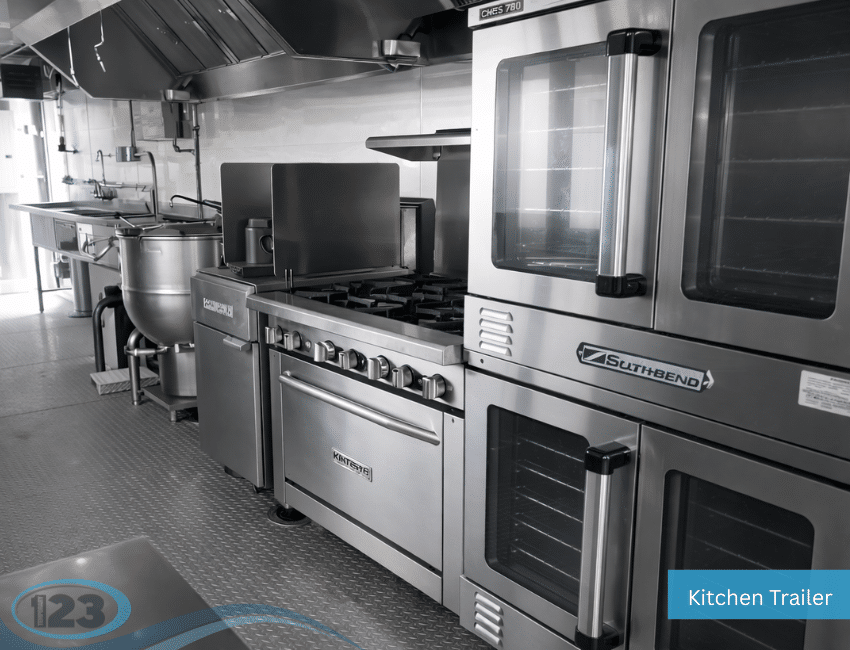
Why Bulk Production Equipment Is So Important in Correctional Facilities
- Tilt skillets
- Steam kettles
- Double-stack convection ovens
- High-volume hot holding cabinets
- Large refrigeration systems
- Bulk prep tables
- Industrial tray-line systems
| Equipment Type | Main Correctional Use | Operational Advantage |
|---|---|---|
| Tilt Skillet | Bulk protein and vegetable production | Fast high-volume cooking |
| Steam Kettle | Soup, pasta, rice, sauces | Efficient large-batch production |
| Double-Stack Oven | Roasting and baking | High production capacity |
| Hot Holding Cabinet | Tray-line staging | Supports timed meal distribution |
| Bulk Refrigeration | Food inventory protection | Supports large meal counts |
Why Security Changes Every Part of Temporary Kitchen Planning
Security affects almost every operational decision inside a correctional facility.
Temporary kitchen deployments may require:
- Controlled delivery routes
- Escorted vendor access
- Secure waste removal procedures
- Restricted tool management
- Limited contractor movement
- Controlled inmate work programs
- Temporary fencing or barriers
- Camera coverage adjustments
Even something simple like placing a refrigeration trailer can become complicated because the location must support both operational access and institutional security.
Correctional foodservice continuity planning often requires coordination between:
- Facility leadership
- Foodservice directors
- Security teams
- Construction managers
- Utility contractors
- Maintenance departments
- State correctional agencies
- Health inspectors
Without strong coordination, small operational problems can create much larger institutional issues.
Why Refrigeration Stability Is One of the Biggest Risks
Correctional facilities maintain large food inventories because meal production must continue consistently every day.
Refrigeration systems protect:
- Proteins
- Dairy products
- Produce
- Frozen inventory
- Prepared meals
- Bulk ingredients
During renovations, permanent refrigeration systems may become unavailable or unstable because of utility work.
Temporary refrigeration trailers and freezer containers help maintain inventory continuity while construction continues.
Organizations reviewing resilience planning are also studying how foodservice providers handle supply chains during emergency deployments because inventory stability becomes critical during long-term correctional renovations.
Refrigeration failures can create serious operational problems quickly because replacement inventory may not arrive fast enough for large institutional feeding operations.
Food safety guidance from USDA FSIS and CDC Food Safety both emphasize the importance of temperature control during institutional food production.
Why Dishwashing and Wastewater Become Hidden Bottlenecks
Warewashing systems are another major operational issue during prison kitchen renovations.
Many correctional facilities use reusable trays, utensils, pans, and serving systems because disposable service can create inventory control and waste management challenges.
Temporary dishwashing systems may therefore become necessary during long-term construction projects.
| Service Style | Main Benefit | Main Challenge |
|---|---|---|
| Reusable Tray Systems | Supports existing secure feeding workflows | Requires warewashing infrastructure |
| Disposable Service | Reduces dishwashing demand | Increases trash and inventory management |
| Hybrid Feeding Model | Flexible during phased renovations | More complicated operational coordination |
Wastewater planning also becomes critical because dishwashing systems generate large amounts of greywater.
Temporary 123 materials discuss wastewater tanks, pump-out scheduling, sanitation support, and water service for temporary infrastructure projects.
If wastewater planning fails, sanitation systems slow down quickly and meal production can become unstable.
Power Planning During Correctional Renovations
Power planning is one of the biggest technical challenges during prison foodservice continuity projects.
Correctional facilities already operate complex electrical systems for:
- Security controls
- Lighting
- Locks and gates
- HVAC systems
- Surveillance
- Communications
- Kitchen equipment
Construction projects may involve temporary shutdowns, rerouted circuits, generator tie-ins, and utility upgrades.
Temporary kitchens therefore need careful electrical planning before deployment.
| Temporary Unit | Typical Power Need | Main Operational Concern |
|---|---|---|
| 24–28 ft Kitchen Trailer | 100–150 amps | Supports standard institutional production |
| 40 ft Kitchen Trailer | 200–220 amps | Supports higher meal counts |
| Dishwashing Trailer | 125–220 amps | Supports reusable tray systems |
| Refrigeration Trailer | 40–60 amps | Protects food inventory |
Temporary Kitchens 123 operational materials explain that utility coordination should begin early because delayed electrical preparation is one of the most common deployment problems.
How Multi-Phase Construction Changes Correctional Workflows
Most correctional renovations happen in phases because the facility remains active during construction.
That means foodservice workflows may change several times throughout the project.
Meal production zones may move temporarily. Delivery routes may change. Storage areas may shrink during one phase and expand during another.
Some facilities temporarily simplify menus during major renovation periods because consistency becomes more important than menu variety.
Others redesign tray-line timing to reduce congestion near active construction zones.
The operational challenge is not only building new kitchen space. The challenge is maintaining institutional stability while construction continues around the facility.
Case Study: Multi-Phase Correctional Kitchen Renovation
A large correctional facility began a multi-phase kitchen renovation project that affected production areas, warewashing systems, refrigeration rooms, and loading access.
Facility leadership wanted to avoid major operational disruption while construction continued.
The continuity deployment included:
- Temporary bulk kitchen systems
- Refrigeration trailers
- Temporary tray assembly areas
- Backup wastewater support
- Generator coordination
- Secure vendor access procedures
The facility maintained more than 7,000 meals daily throughout the project while construction continued in stages.
One of the biggest lessons from the renovation was that communication between foodservice teams and security leadership became just as important as the equipment itself.
The facility also adjusted meal schedules temporarily during high-impact construction periods to reduce operational congestion.
Why Correctional Facilities Are Treating Foodservice as Critical Infrastructure
Correctional systems are beginning to treat foodservice continuity more like infrastructure resilience instead of routine operations.
Foodservice affects:
- Institutional stability
- Staff coordination
- Security scheduling
- Emergency preparedness
- Inmate movement
- Operational continuity
Facilities reviewing future resilience planning are also studying mobile kitchens and the future of resilient urban infrastructure because continuity planning is becoming more important across government and institutional operations.
Future correctional deployments may include:
- Remote refrigeration monitoring
- Improved wastewater systems
- AI-based inventory tracking
- More modular kitchen infrastructure
- Faster deployment planning
- Integrated emergency feeding systems
Bottom Line
Correctional facilities planning temporary foodservice continuity projects often review guidance from agencies like OSHA, CDC, USDA FSIS, NFPA, and FEMA when planning sanitation systems, worker safety, emergency feeding, ventilation, and infrastructure continuity.
Facilities also increasingly review weather and infrastructure risk data from NOAA because storms, utility failures, and climate-related disruptions increasingly affect institutional continuity planning.
Request a Quote
Every project is different.
Contact us today to get a customized solution for your needs.
Call Temporary Kitchens 123 at

Frequently Asked Questions
Why do correctional facilities use temporary kitchens during renovations?
Correctional facilities use temporary kitchens to maintain uninterrupted inmate feeding, sanitation, and operational continuity while permanent kitchens undergo phased construction or infrastructure upgrades.
Can prisons continue secure feeding operations during kitchen construction?
Yes. Temporary bulk kitchens, refrigeration systems, secure tray-line workflows, and phased renovation planning help facilities continue secure meal production during construction projects.
What is the biggest operational challenge during prison kitchen renovations?
Security coordination, refrigeration stability, wastewater handling, tray-line timing, and utility planning are some of the biggest operational challenges during correctional continuity projects.
Do correctional facilities use temporary refrigeration during renovations?
Yes. Temporary refrigeration trailers and freezer containers help protect institutional food inventory during utility work and phased construction.
How long do correctional kitchen continuity projects usually last?
Many correctional kitchen renovations continue for several months or years depending on the size of the facility and the complexity of the infrastructure upgrades.