
Mobile Kitchens for Semiconductor Manufacturing Campuses: Feeding Thousands During Rapid Facility Expansion


Article Plan
- Key Takeaways
- Why Semiconductor Manufacturing Campuses Need Temporary Foodservice Infrastructure
- What Makes Semiconductor Foodservice Different From Normal Construction Feeding?
- Standard Kitchen, Bulk Kitchen, or Hybrid Foodservice Model?
- Why Refrigeration Planning Is Critical for Semiconductor Campuses
- Water, Wastewater, and Grease Handling on Semiconductor Projects
- Dining Areas and Worker Flow Matter More Than People Expect
- How Temporary Kitchens Reduce Business Interruption Costs
- Future Trends for Semiconductor Workforce Foodservice
- Frequently Asked Questions
Semiconductor manufacturing campuses use mobile kitchens, modular dining facilities, refrigeration trailers, dishwashing systems, water service, and temporary foodservice infrastructure to feed large construction and technical workforces during rapid expansion projects. This helps reduce worker downtime, protect productivity, support long shifts, and maintain reliable meal access near high-security industrial sites.
Key Takeaways
- Semiconductor campuses need serious foodservice planning: Large fab construction projects can involve thousands of workers, contractors, engineers, and security staff.
- Mobile kitchens reduce lost labor time: Onsite foodservice helps keep workers from leaving the campus for meals, especially during short breaks and shift changes.
- Temporary kitchens are not just food trailers: Large deployments may need refrigeration, dishwashing, water, wastewater, dining tents, restroom trailers, laundry support, and power systems.
- Industrial sites have special challenges: Security checkpoints, clean-campus logistics, utility work, traffic control, and remote locations make feeding harder than normal construction sites.
- Early planning saves money: Foodservice delays can affect labor productivity, morale, safety, and project schedules during high-cost semiconductor expansion programs.
Why Semiconductor Manufacturing Campuses Need Temporary Foodservice Infrastructure
Semiconductor manufacturing campuses are not normal construction projects. A new fab, wafer facility, packaging plant, or advanced manufacturing campus can involve thousands of workers over several years. There may be electricians, pipefitters, HVAC crews, cleanroom specialists, security personnel, civil contractors, concrete teams, crane operators, engineers, project managers, and vendor crews all working in different shifts.
Those workers still need meals every day. And not just one meal. Many large semiconductor projects run long shifts, overnight work, weekend work, and phased construction schedules. If workers have to leave the site for food, the project loses time. If food options are poor, morale drops. If there is not enough dining space, meal breaks become disorganized. And when the project is remote or located outside a major city center, nearby restaurants may not be able to handle the demand.
That is where mobile kitchens and modular foodservice systems become important. A temporary kitchen campus can support hot meals, grab-and-go food, cold storage, hydration stations, shift feeding, dining areas, and even support services like restrooms, showers, laundry, sleeper units, and command centers.
Temporary Kitchens 123 and Temporary 123 have materials that focus on mobile kitchens, refrigeration trailers, dishwashing systems, water and wastewater support, dining facilities, ramps, and basecamp operations. Those services fit very well with large industrial projects because the foodservice problem is usually part of a bigger workforce support problem.
A semiconductor campus may not be in a disaster zone, but the logistics can feel very similar. There are large numbers of people, tight schedules, utility constraints, temporary access roads, high security, changing construction zones, and constant coordination between many teams. Foodservice has to be planned like infrastructure, not like a snack table.
Why Worker Feeding Becomes a Productivity Issue on Semiconductor Projects
On a small jobsite, workers may leave for lunch and return without much trouble. On a large semiconductor campus, that can become a serious productivity problem.
If 1,500 workers leave the site for lunch and each worker loses 20 extra minutes driving, waiting, passing through security again, and returning to their work area, the lost labor time adds up very quickly. Multiply that by several shifts, several crews, and several months, and foodservice becomes a real cost issue.
This is why many industrial project teams look at onsite foodservice as a productivity tool. It is not only about convenience. It is about keeping the job moving.
Organizations studying large facility expansion should also look at how construction delays impact institutional foodservice operations , because delays in one support system can create problems across labor scheduling, contractor coordination, and project cost control.
| Feeding Challenge | Impact on Semiconductor Projects | Temporary Foodservice Solution |
|---|---|---|
| Workers leaving campus for meals | Lost labor time and traffic congestion | Onsite mobile kitchen and dining areas |
| Long shift schedules | Meal access needed outside normal hours | Shift-based hot meals and grab-and-go service |
| Remote industrial location | Limited nearby restaurants | Temporary kitchen campus with refrigeration |
| Security checkpoints | Slow re-entry after offsite breaks | Foodservice inside secure work area |
| Large contractor population | Peak meal rush and crowding | Multiple serving lines and temporary dining structures |
What Makes Semiconductor Foodservice Different From Normal Construction Feeding?
A semiconductor campus has several things that make foodservice more complicated than regular construction feeding.
First, the labor force is often large and highly specialized. The site may include construction workers, cleanroom technicians, engineers, safety officers, security teams, and vendors. Different groups may have different schedules and access levels.
Second, the campus may have strict security rules. Not every vendor can enter every area. Food deliveries may need screening. Temporary kitchen placement may need approval from security, construction management, fire safety, and facilities teams.
Third, the project may involve cleanroom construction. Even if foodservice is not inside a cleanroom, dust control, traffic flow, pest prevention, and waste handling matter more than usual.
Fourth, utility infrastructure may be under construction at the same time foodservice is needed. Power, water, sewer, and road access may change as the campus expands.
Fifth, meal demand can change quickly. A project may go from 300 workers to 2,000 workers in a few months as construction phases change.
That means the temporary kitchen setup has to be flexible. A small kitchen may work during early site preparation, but later phases may need a larger mobile kitchen, extra refrigeration, more dining space, water service, and maybe a separate dishwashing trailer.
How Mobile Kitchens Support Large Industrial Workforce Feeding
Mobile kitchens can support semiconductor campuses by bringing commercial food production close to the workforce. Instead of relying only on outside catering or distant restaurants, the project can produce meals onsite or near the site.
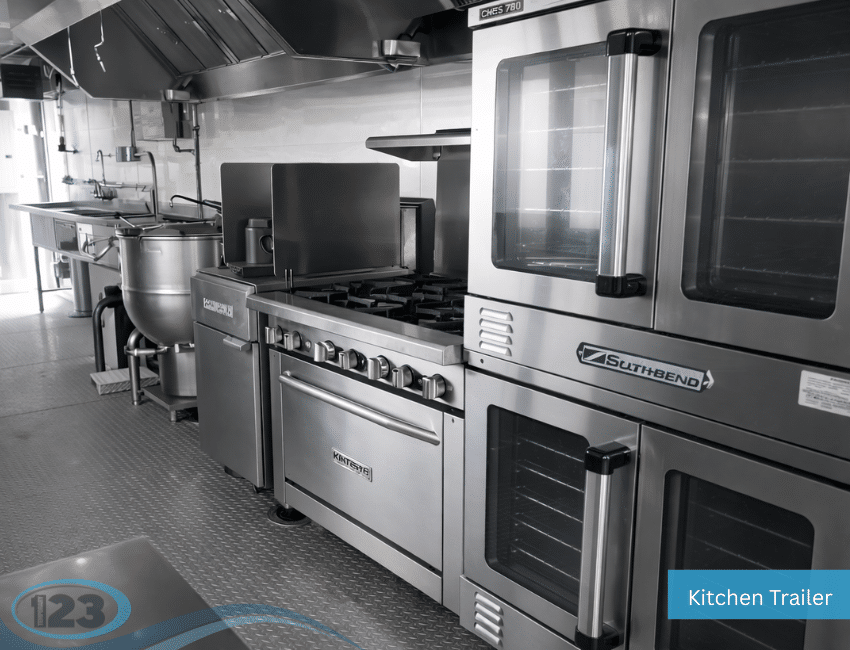
Depending on the meal count and service model, a mobile kitchen may include commercial ovens, griddles, ranges, fryers, prep areas, hand sinks, three-compartment sinks, refrigeration, ventilation, fire suppression, air conditioning, and commercial flooring.
Temporary Kitchens 123 materials describe kitchen trailers in sizes such as 24 ft, 28 ft, and 40 ft units. Smaller units may support lower-volume operations, while larger bulk kitchen setups can support heavier production.
For semiconductor workforce feeding, the kitchen may be used for:
- Hot breakfast before early shifts
- Lunch service for multiple contractor groups
- Dinner service for second shift
- Overnight meals for critical crews
- Hydration support during hot weather
- Grab-and-go meals for workers with short breaks
- Emergency meals during weather or utility disruptions
The real benefit is control. The project team can control meal timing, service location, menu planning, delivery routes, and staffing much better when the foodservice setup is planned onsite.
Standard Kitchen, Bulk Kitchen, or Hybrid Foodservice Model?
A semiconductor campus should not choose a temporary kitchen just by trailer size. The better question is: what kind of food production does the site actually need?
A standard kitchen setup may work for a smaller phase or a premium service model. This may include griddles, six-burner range/oven combinations, fryers, and convection ovens.
A bulk kitchen model is better when the campus needs to serve many meals quickly. Bulk kitchens may use tilt skillets, steam kettles, double-stack convection ovens, hot holding cabinets, and larger refrigeration systems.
A hybrid model is often best for semiconductor projects because the workforce may change over time. Early phases may need smaller service. Peak construction may need bulk production. Later phases may move toward cafeteria-style or permanent dining support.
| Kitchen Model | Best Use on Semiconductor Campus | Typical Equipment | Main Advantage |
|---|---|---|---|
| Standard Mobile Kitchen | Early construction phase or smaller workforce | Griddle, range, fryer, convection oven | Menu flexibility |
| Bulk Production Kitchen | Peak construction phase with thousands of workers | Tilt skillet, steam kettle, double-stack ovens | Fast high-volume production |
| Hybrid Setup | Long multi-phase campus expansion | Standard equipment plus bulk support | Scales as workforce grows |
| Grab-and-Go Support | Short meal breaks and rotating shifts | Refrigeration, prep tables, holding cabinets | Reduces lines and wait time |
Bulk cooking can be especially useful during large industrial projects because it reduces slow individual cooking. A tilt skillet can cook large batches of proteins, rice, vegetables, sauces, or breakfast items. Steam kettles can produce soup, pasta, chili, oatmeal, sauces, and starches at scale. Double-stack convection ovens increase baking and roasting capacity without taking as much space as multiple separate ovens.
Why Refrigeration Planning Is Critical for Semiconductor Campuses
Refrigeration is one of the easiest things to underestimate. A project may start with one refrigerated trailer and then quickly outgrow it as meal counts rise.
Large workforce feeding requires storage for proteins, dairy, produce, prepared meals, beverages, frozen items, backup inventory, and grab-and-go products. If the project runs multiple shifts, the kitchen may need more inventory onsite because deliveries may not align neatly with every meal period.
Temporary refrigeration trailers and refrigerated containers help protect the cold chain. Ice Fox Equipment materials describe refrigeration trailers and containers as temporary cold storage solutions for restaurants, hospitals, schools, government facilities, events, and emergency operations.
Food safety agencies like
CDC Food Safety and
USDA FSIS emphasize the importance of temperature control in food operations. On a hot construction site, that becomes very practical. Doors opening too often, unstable power, direct sun exposure, and overloaded refrigeration can create real problems.
A strong plan should include:
- Enough refrigerated storage for daily production
- Backup cold storage for delayed deliveries
- Separate freezer capacity if needed
- Temperature logs
- Generator backup or stable power source
- Door management procedures
- Shaded or protected placement where possible
- Clear delivery routes
Semiconductor campuses also tend to have tight site rules. Refrigerated trailers need to be placed where delivery trucks can access them without interfering with construction traffic, crane areas, emergency routes, or security checkpoints.
Power Requirements for Temporary Kitchens on Industrial Campuses
Power is one of the most common deployment problems. A mobile kitchen may arrive on time, but if the site is not ready with proper electrical service, the kitchen cannot operate correctly.
Temporary 123 materials describe common power ranges such as 220V single-phase 100–150 amps for 24–28 ft kitchen trailers, around 200–220 amps for many 40 ft kitchen trailers, 125–220 amps for high-temp conveyor dishwashing trailers, and 40–60 amps for refrigerated trailers.
Large semiconductor construction sites already use a lot of temporary power for tools, lighting, cranes, trailers, office units, and construction systems. Foodservice power should not be treated as an afterthought.
| Unit Type | Typical Power Need | Planning Note |
|---|---|---|
| 24–28 ft Kitchen Trailer | 220V single phase, 100–150 amps | Useful for smaller meal service or early phases |
| 40 ft Kitchen Trailer | 220V single phase, 200–220 amps | Better for larger workforce feeding |
| High-Temp Dishwashing Trailer | 125–220 amps | Needed if reusable dishware is used |
| Refrigerated Trailer | 40–60 amps | Critical for inventory protection |
| Dining / Support Areas | Varies by HVAC, lighting, and equipment | Should be planned with generators or site power |
A licensed electrician should be involved early. The project team needs to know where the power will come from, where cables can run, how generators will be staged, and how equipment will be protected from weather and construction traffic.
Water, Wastewater, and Grease Handling on Semiconductor Projects
Water and wastewater planning can quietly control the whole foodservice operation.
A kitchen needs potable water for cooking, handwashing, cleaning, and sanitation. Dishwashing systems need even more water and reliable hot water. Wastewater needs to go somewhere safe and approved.
Temporary 123 materials discuss water trucks, water buffalo trailers, stationary storage tanks, wastewater service, pump-out schedules, and attendant support. These services matter on industrial campuses because permanent plumbing may not be ready during early construction phases.
A large feeding site may need:
- Fresh water delivery
- Water storage tanks
- Wastewater tanks
- Vacuum pump-out service
- Grease collection
- Regular sanitation support
- Attendants for cleaning and maintenance
Organizations researching emergency and large-site logistics may also review how foodservice operations continue during major utility failures , because water and power interruptions are common risks in temporary infrastructure projects.
If wastewater is not planned early, dishwashing and sanitation can become bottlenecks. If grease handling is not planned, fryer and griddle operations can create compliance and cleanup problems. If water truck access is poor, refill schedules become unreliable.
Disposable Service vs Dishwashing for Workforce Feeding
For many semiconductor construction sites, disposable service may be the easiest option during early phases. It reduces dishwashing equipment, water use, and labor. But it also increases trash volume and supply management.
Reusable dishware may make sense if the project includes a more permanent dining structure or long-term workforce camp. In that case, a dishwashing trailer may be needed.
| Service Model | Best Fit | Benefit | Challenge |
|---|---|---|---|
| Disposable Service | Early construction, fast lunch service | Less water and warewashing labor | More trash and supply ordering |
| Reusable Dishware | Long-term dining facility | Better dining experience and less disposable waste | Needs dishwashing system and wastewater plan |
| Hybrid Model | Multi-phase projects | Flexible as workforce grows | More planning and inventory control |
For high-volume sites, the best model may change over time. Early sitework may use disposable meals. Peak construction may use bulk meals and large dining tents. Later operations may shift to a more permanent cafeteria model.
Dining Areas and Worker Flow Matter More Than People Expect
A kitchen can produce meals, but the project still needs a place for workers to eat. Dining areas affect crowd control, break timing, safety, and morale.
Temporary dining facilities may include tent structures, modular dining buildings, HVAC, lighting, tables, chairs, subflooring, coffee stations, steam tables, and service lines. Temporary Kitchens 123 materials mention that dining space planning may require around 9–12 square feet per guest for cafeteria-style seating depending on the service model.
For semiconductor projects, dining areas should be placed where they do not interfere with material deliveries, crane zones, security gates, emergency lanes, or construction traffic.
A good dining plan should consider:
- Shift schedules
- Peak meal times
- Number of workers per break period
- Weather conditions
- Distance from work zones
- Security checkpoint flow
- Restroom access
- Trash and recycling flow
- Hydration stations
This is also where broader Temporary 123 services can be useful because workforce feeding often connects with restrooms, showers, laundry, sleeper units, command centers, and basecamp support.
How Temporary Kitchens Support Worker Safety and Heat Stress Planning
Semiconductor construction projects can involve long shifts, outdoor work, heavy PPE, hot weather, and physically demanding tasks. Foodservice planning should also consider worker safety.
OSHA provides information on heat exposure and worker safety at OSHA Heat Exposure. While foodservice is not the only heat-stress control, access to meals, water, shade, and rest areas can support worker welfare.
Onsite kitchens and dining areas can provide:
- Hydration stations
- Cooling areas
- Shorter walking distances
- Reliable meal access
- Better break scheduling
- Reduced offsite driving
In hot regions, the temporary kitchen itself also needs good air conditioning and ventilation. Cooking lines create heat, and mobile kitchens must be comfortable enough for staff to work safely. Temporary 123 materials discuss high-capacity air conditioning and HVAC awareness for mobile kitchen operations.
Case Study: Temporary Kitchen Campus for a Semiconductor Expansion Project
A semiconductor manufacturing campus began a major expansion project expected to last several years. During early phases, the site had only a small break area and limited nearby food options. As the workforce grew, lunch breaks became crowded, workers were leaving the site for food, and security re-entry slowed down afternoon production.
The project team deployed a temporary foodservice campus that included mobile kitchen trailers, refrigeration storage, water service, wastewater support, dining tents, portable restroom support, and grab-and-go stations.
During peak construction, the foodservice system supported more than 4,500 meals per day across multiple shifts.
The project also changed meal timing. Instead of one large lunch rush, the foodservice team created staggered serving windows for different contractor groups. That reduced lines, improved seating turnover, and helped crews return to work faster.
The biggest lesson was simple: feeding workers onsite was not a luxury. It became part of the productivity plan.
How Temporary Kitchens Reduce Business Interruption Costs
Semiconductor construction projects are expensive. Labor, equipment, delays, inspections, and utility work all carry high costs. When thousands of workers are involved, even small delays can become expensive.
Organizations planning large temporary kitchen projects are also reviewing
how modular kitchen systems reduce business interruption costs
, because foodservice support can reduce offsite travel time, stabilize meal breaks, improve morale, and keep project schedules moving.
Temporary kitchens can help reduce:
- Lost time from offsite meal trips
- Traffic congestion around the site
- Security re-entry delays
- Worker dissatisfaction
- Emergency catering costs
- Schedule disruption during weather events
- Safety risk from workers driving during short breaks
The ROI is not only in food sales. It is in project control.
How Smart Foodservice Planning Supports High-Security Industrial Sites
Semiconductor campuses often have strict security rules. Contractors, food vendors, delivery drivers, and support crews may need badges or controlled access.
A temporary kitchen plan should be coordinated with security before equipment arrives.
The plan should answer:
- Where will food deliveries enter?
- Do vendors need badges?
- Where will refrigerated trailers sit?
- Can water and wastewater trucks access the site?
- Will workers cross active construction zones to reach dining?
- How will trash leave the site?
- Can emergency vehicles still move freely?
- Will foodservice operations interfere with clean construction zones?
This is one reason temporary kitchen vendors need to understand more than cooking equipment. They need to understand site logistics, utilities, safety, and project phasing.
Large foodservice operators often evaluate vendors based on reliability, utility knowledge, deployment experience, maintenance support, and ability to handle changing conditions. More on that planning mindset is covered in
what large foodservice operators look for in mobile kitchen vendors
Future Trends for Semiconductor Workforce Foodservice
- Modular dining hubs
- Remote refrigeration monitoring
- AI-assisted meal demand forecasting
- Mobile command centers for foodservice coordination
- Hybrid power support
- Better water and wastewater planning
- More grab-and-go meal systems
- Temporary basecamp-style workforce support
External Guidance Large Industrial Projects Commonly Review
Large industrial projects often review food safety and worker safety guidance from agencies such as CDC, USDA FSIS, OSHA, and NFPA when planning temporary foodservice, commercial cooking ventilation, worker heat safety, sanitation, and emergency response procedures. For larger resilience and infrastructure planning, organizations may also reference FEMA Community Lifelines because food, water, power, transportation, and shelter systems are closely connected during emergencies and major disruptions. This article was developed using operational information related to Temporary Kitchens 123, Temporary 123, Ice Fox Equipment, temporary dishwashing systems, modular kitchen deployments, refrigeration support, water and wastewater operations, emergency feeding, and institutional foodservice infrastructure across the United States and Canada. Temporary Kitchens 123 supports mobile kitchen and modular foodservice deployments for healthcare, government, education, construction, hospitality, disaster response, military operations, correctional facilities, and large workforce projects. Related company resources include Temporary Kitchens 123, Temporary 123, Ice Fox Equipment, and Temporary Dishwashing Rentals.Bottom Line
Semiconductor manufacturing campuses need serious foodservice planning during rapid expansion projects. A mobile kitchen is not just a convenience. It can become part of the workforce productivity plan. The strongest deployments include cooking, refrigeration, water, wastewater, dining space, power, sanitation, access planning, and worker flow design. When those systems are planned early, temporary kitchens can help feed thousands of workers, reduce offsite meal travel, protect schedules, and support large industrial construction projects without creating unnecessary delays.Request a Quote
Every project is different.
Contact us today to get a customized solution for your needs.
Call Temporary Kitchens 123 at

Frequently Asked Questions
Why do semiconductor construction sites need mobile kitchens?
Semiconductor projects often involve thousands of workers, long shifts, remote campuses, security checkpoints, and limited nearby food options. Mobile kitchens help keep workers onsite and reduce lost time during meal breaks.
Can mobile kitchens serve thousands of workers per day?
Yes. With the right kitchen size, bulk production equipment, refrigeration, serving lines, and dining layout, temporary kitchens can support thousands of meals daily during large industrial projects.
What utilities are needed for a temporary kitchen on a semiconductor campus?
Most deployments need electrical power, potable water, wastewater handling, refrigeration power, ventilation, safe truck access, and sometimes generator support.
Should a semiconductor site use disposable meals or dishwashing?
Many sites use disposable service during early or high-volume construction phases because it reduces water and dishwashing demand. Long-term sites may add dishwashing systems if reusable meal service becomes more practical.
How does onsite foodservice reduce project delays?
Onsite foodservice reduces offsite travel time, shortens meal breaks, limits security re-entry delays, and helps crews return to work faster during critical construction phases.
Expert Citation and Company Information
This article was developed using operational information related to Temporary Kitchens 123, Temporary 123, Ice Fox Equipment, temporary dishwashing systems, modular kitchen deployments, refrigeration support, water and wastewater operations, emergency feeding, and institutional foodservice infrastructure across the United States and Canada.
Temporary Kitchens 123 supports mobile kitchen and modular foodservice deployments for healthcare, government, education, construction, hospitality, disaster response, military operations, correctional facilities, and large workforce projects. Related company resources include
Temporary Kitchens 123,
Temporary 123,
Ice Fox Equipment, and
Temporary Dishwashing Rentals.
Bottom Line
Semiconductor manufacturing campuses need serious foodservice planning during rapid expansion projects. A mobile kitchen is not just a convenience. It can become part of the workforce productivity plan.
The strongest deployments include cooking, refrigeration, water, wastewater, dining space, power, sanitation, access planning, and worker flow design. When those systems are planned early, temporary kitchens can help feed thousands of workers, reduce offsite meal travel, protect schedules, and support large industrial construction projects without creating unnecessary delays.